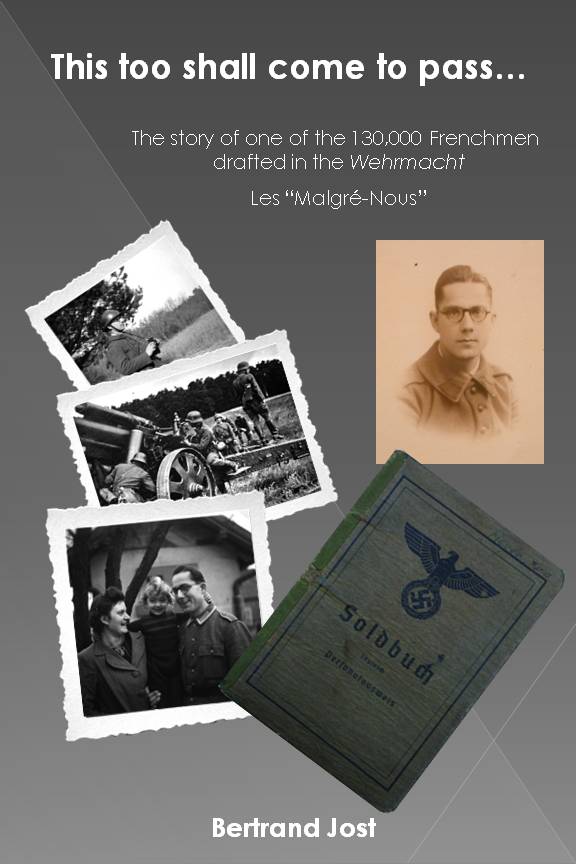
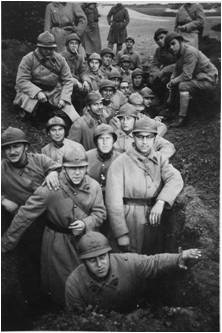
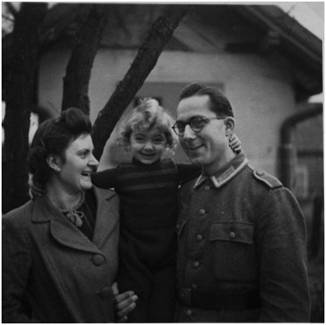
August 25, 1942. A day of infamy for Alsace-Lorraine. The Nazis have just decided to draft all Frenchmen of Alsace and Lorraine in the Wehrmacht, the German Army. Later, many would even be drafted in the infamous “Waffen SS”. For Marius Meyer, my grandfather, the draft date was April 16, 1943, not even three years after he had been discharged from the French Army in the wake of the tragic defeat of 1940. But he has no choice for the draft dodgers see their families deported somewhere to the East. So he leaves his wife and daughter to go to war, once again. His destination is Kustrin, in Eastern Germany, a few steps closer to the much feared Russian Front…
Marius wrote the following poem about this painful moment of departure:
“Now goodbye you, my dear homeland
Dear land of Alsace, goodbye!
We must go to a remote land!
Dear land of Alsace, goodbye!
And we leave with some … feeling.
Gone to the Wehrmacht into the uniform –
Dear homeland, oh dear!
[ ]
Thus they went through the town and land
And were soon recognized everywhere
A far-out hand wave, last moment of bliss
And all this was already part of the past.
And always resonates of home this melody
Like the complaints of the little flower from ‘Forget me not!’”
_________________________________________________________________________
This book is the story of my Grandfather, one of the
130,000 Frenchmen
drafted in the German Army during World War II. 32,000
of them would be killed
in action and 10,500 are still missing in action to this
day.
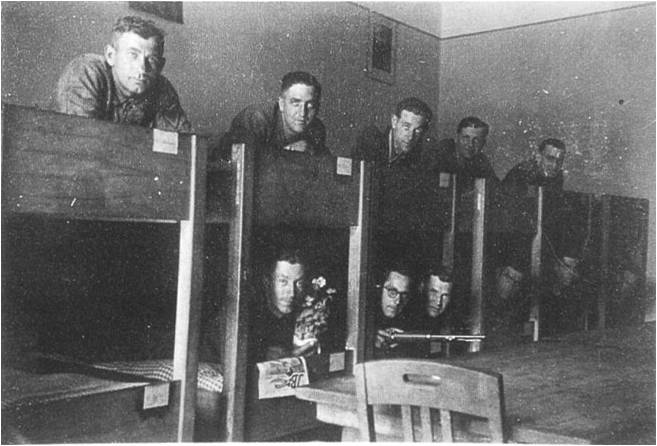
Marius in his dorm in Kustrin (bottom row with riffle) - 1943
Special features:
What makes the book special are the postcards and documents of the time that show the state of mind of the various actors during these events. For instance, on September 20, 1939, as he arrives in Paris en route to his draft assignment, Marius wrote the following card to his wife as France has now been at war for 17 days:
“September 20, 1939,
My little wife,
Here I am in Paris after a train ride of 15 hours! Menzer from Sélestat is with me. We took a room to rest. We were exhausted from tiredness and wanted to sleep. Tomorrow we are off to Orléans. Paris is no longer Paris. The activity is greatly reduced, but life is normal and quiet. In the train I saw my French teacher from Phalsbourg. She was delighted [to see me]. I hope that you are back in shape from your illness. I hope so from the bottom of my heart. Is there anything new at home?
Greet everyone for me, especially Mommy, Daddy and Léonie.
A thousand kisses. Your Marius.”
Four years later, in September 1943, as Marius was now a
German
soldier, he tried to escape his fate by faking an
accident and inflicting
himself a wound. The army doctor spotted the lie and
sent him back to his unit
to be trialed. On September 11 as he arrived to his
base, Marius wrote the
following letter to his family doctor, begging him for
help in his coming
ordeal:
“September 11, 1943 [Kustrin, Germany]
Dear Doctor!
I arrived safe and sound. In Strasbourg we had to wait a long time during the air raid alert, while outside there was heavy bombing. And from what I heard afterwards, it resulted in a lot of victims and homeless; and this right in the middle of the day. Otherwise the trip ended without incident. At my arrival my friends were already leaving to the East. Nevertheless five friends and myself were not sent because on September 15 we’ll be enrolled in an additional training of several months. I am here in treatment, not intensive, lighter duty and I must get some X rays next Thursday in the event that there were complications. I had already forgotten about the check-in in Stephansfeld and I had resigned myself [to go on]. Therefore, it was a great surprise for me, when today I was summoned by the Court Officer because of a communication from the hospital stating that I was at fault for arriving one day late and for having used a civilian doctor. Then I should have reported immediately after receiving the summons from the town employee (Mr. Ambs was recorded as town employee, and this must remain as such. His name has no importance anyway.) I had to submit a written report that I am enclosing to this letter. Everything is fine up to September 4 (Saturday.) Why was the military doctor not called? It is now up to you to clarify the story for me to avoid a punishment. You have my statement that you can confirm anytime which would clear this case as soon as your response arrives. I will also send you the town employee Ambs. Perhaps you could be able to obtain from the doctor that he withdraws himself his statement and confirms my innocence. This would spare me unnecessary problems.
With all my thanks.
Sincerely yours. Meyer.”
Outline of the book
Prologue
I - Early Years
II - Lost Dump
III - The gust of Thorns
IV - Learning to live under the stick
V - Teacher in the Reich
VI - The Malgré-nous of Alsace-Lorraine
VII
- Soldatenstadt Küstrin
VIII - Everything will come to pass, Everything will come to an end
IX - Nowhere to run
X - Painful Getaways
XI - Moving Underground
XII - Freedom at Last
XIII - Operation Nordwind
XIV- Witch Hunt
Epilogue
About the Author
Bertrand Jost grew up in Alsace, France. In 1991, he moved to the United States. He now lives in New York City where he works as a credit analyst in a large international bank. Simultaneously, Bertrand Jost wrote various articles and books (mostly in French) focusing on Alsatian history.
Bibliography
Kocherschbari
no64 – Winter
2011
«La
guillotine à
Hohatzenheim -
L’affaire Nicolas Blaise
(1793-1794)»
Vicissitudes
Militaires
1809-1959
Sept
générations de
conscrits d’une famille alsacienne aux armées de cinq
empires
Volume
3 – Quand nous
étions allemands 1871-1918
Calleva -
October 2011
Vicissitudes
Militaires
1809-1959
Sept
générations de
conscrits d’une famille alsacienne aux armées de cinq
empires
Volume
2 – Le
Prix de la Liberté 1815-1870
Calleva - June
2011
Vicissitudes
Militaires
1809-1959
Sept
générations de
conscrits d’une famille alsacienne aux armées de cinq
empires
Volume
1 - Grandeur et
déchéance 1809-1815
Calleva
– May 2010
Kocherschbari
no56 – Winter
2007
«
Marius Meyer (1917-2006)
– Mémoires inachevées »
Kocherschbari
no56 – Winter 2007
«
Histoire de la libération
de Hohatzenheim et des environs (1944-1948) »
Empire Patriot – Volume 9 Issue 3 – August 2007
« The American War of Independance – A Global War against England »
Kocherschbari no54 – Hiver 2006
«
Une famille de bergers du
Kochersberg : les Jost entre 1726 et 1789 »
Kocherschbari
no50 – Hiver 2004
«
Hohatzenheim n’est pas le
domaine des dieux – Etymologie du nom du village »
Applied Mathematics and Computation - Volume 71, Issue 1 - August 1995
« A critical analysis of the numerical and analytical methods used in the construction of the lunar gravity potential model »