Please join me on Goodreads
or write me your comments and questions at
.......... durandal.strike@gmail.com ________________________________________
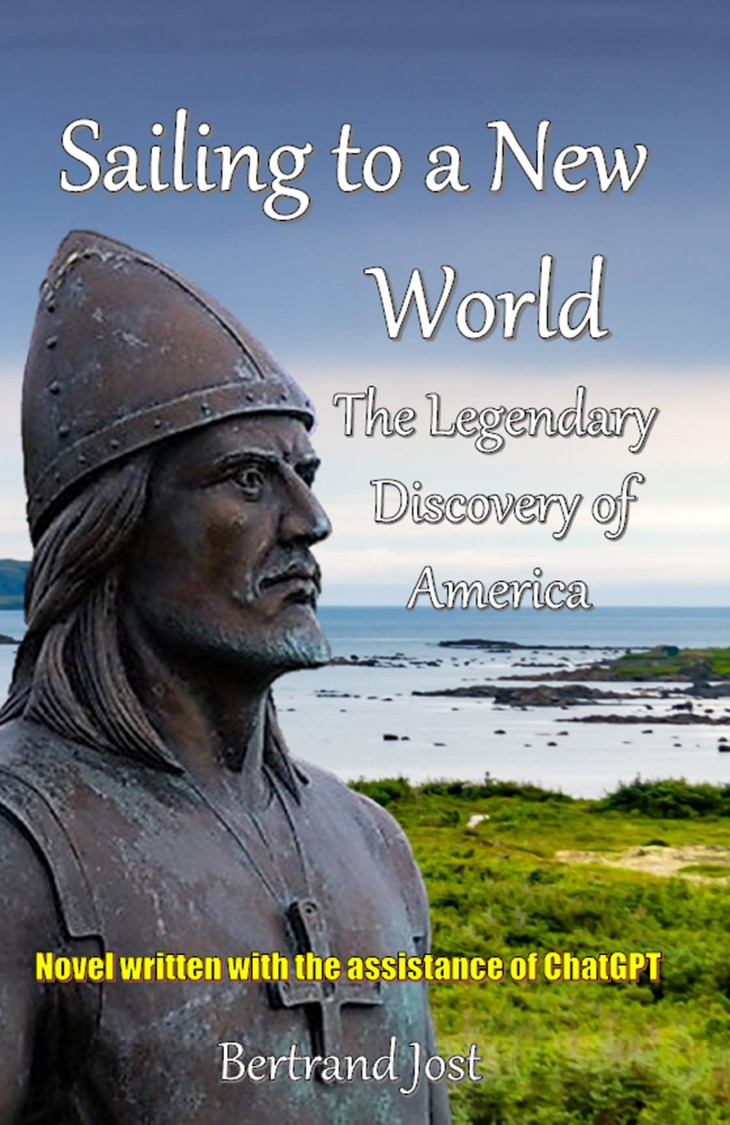
Sailing to a New World
- The Legendary Discovery of America
This book deals with a topic that has long been of great
interest to me: the discovery of America by the Vikings
at the turn of the first millennium. It is a novel
divided into two parts. In the first part, the story
follows and builds on the episodes of two Icelandic
sagas (the Saga of Erik the Red and the Saga of the
Greenlanders) that recount the arrival of the Norse in
Greenland and from there various voyages to America.
The second part is based on my own extrapolation of
other sources such as old legends dealing with the
arrival of Europeans in America and archeological finds
that provide a series of hints of what the Scandinavian
exploration of America might or could have been after
the first trips described in the Saga.
Besides the inherent interest that I had in the topic,
the reason for me to engage in this project now, was
because of the release of ChatGPT in November 2022. As
it has been disclosed in the press (see article below),
my firm Morgan Stanley has initiated a collaboration
with OpenAI to evaluate the use of this tool for various
business applications and I am fortunate enough to be
part of this exciting project. As a result, I was
curious to see how useful ChatGPT could be in assisting
an author in writing a novel. My answer and my analysis
are given in the foreword of the book.
For those who will give me the great honor of reading my
book, I hope that you’ll find as much pleasure in
reading it as I had writing it and for those who will go
as far as writing a comment on Amazon, I will send a
copy of anyone of my books listed on Amazon (4 books in
English and 6 in French) and if you’re local, I can also
sign it for you.
Thank you for your support!
Bertrand
Note: I never use the term “Viking” in the book since
this term appeared in the Middle Ages to refer to
pirates and raiders coming from the North and laying
waste across the continent. But the Norsemen that
settled in Greenland and from there explored America are
far from this description. They were settlers, farmers,
hunters and daring explorers that were just trying to
make a living in an arid land.
Book
Excerpt.... ____________________ “The Norsemen were
startled from their sleep by a piercing cry that
cut through the night. “Awake, Thorvald, you and
all your company, if you want to save your life;
and board your ship with all your men, and sail
from the land as fast as you can.” It was the
voice of Tyrker the German. "What was that?"
Thorvald demanded, already grabbing his weapons.
As they peered into the darkness, they saw canoes
approaching from the fjord. "Prepare yourselves
for battle!" Thorvald ordered his men. They quickly erected makeshift breastworks on
both sides of their ship and hunkered down,
shields at the ready. The Skraelings rained down
arrows upon them, but the Norsemen held their
ground and fought back only as necessary. After
some time, the Skraelings retreated, and the
Norsemen breathed a sigh of relief. Thorvald
surveyed his crew and asked if anyone had been
injured. They all replied in the negative, but
Thorvald himself had been struck. "I've been hit
in the armpit," he grimaced, pulling out the arrow
shaft. "This wound will be my end." He looked around at his men and spoke, "I
advise you to return home as fast as you can, but
bring me to that headland, to the place where I
had decided to settle. I would like to rest there
for a while." As they carried him to the headland,
Thorvald's condition quickly worsened, and he knew
that he wouldn't make it back home. "Bury me here
and place a cross at my head and another at my
feet, and call it Cross-point for ever after," he
said with a weak voice. His men fulfilled his final wish and Thorvald
passed away right there, on this beach of the New
World. The Norsemen solemnly gathered around
Thorvald's grave, which was marked by two crosses
as he had wished. Thorgest, Styr, Thorgrim
Bearkill, and Tyrker the German, stood on one
side, making the sign of the cross while Tyrker
recited a prayer in his native language. Their
faces were solemn, and they kneeled down in front
of the crosses, with their heads bowed. On the
other side, Olaf the bold, Osvald the Bastard, Ulf
Eyiulfson, Thori, Jorund, and Erik Blackbeard
stood, their faces set in grim expressions, as
they whispered incantations to their heathen gods,
Thor and Odin. They were clad in furs and leather,
with their swords at their sides, and their long
hair and beards blowing in the wind.”
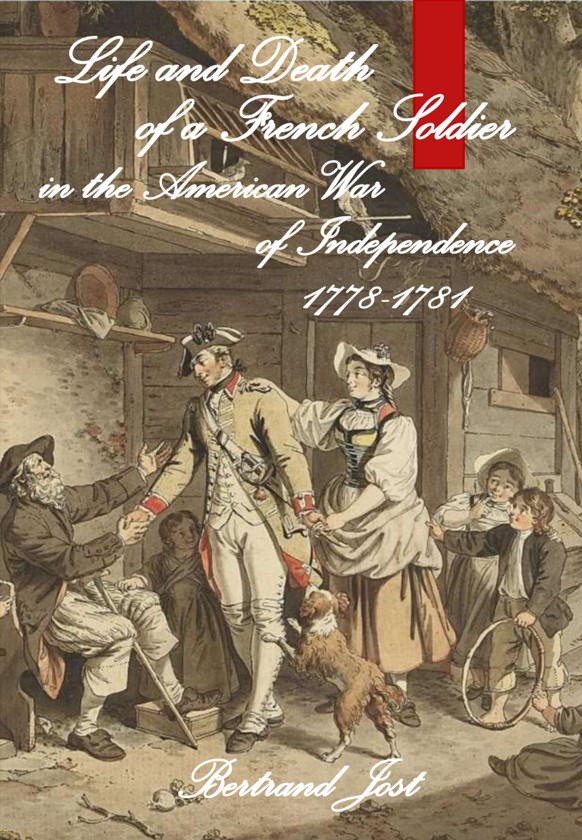
Life
and Death of a French Soldier in the American
War of Independence
This book is the result of more than 15 years of
research (on and off) through which I applied
myself to describe the life of 18th century
enlisted soldiers: socioeconomics of enlisted men,
way of life in the barracks, heavy casualties at
sea and in the colonies and prejudices of
uneducated men when meeting different populations:
slaves, white settlers and American allies. The
result is a contrasted picture quite remote from
the experience of the senior officers who
typically hold the forefront of accounts on that
time period.
in 1778, Hans
Stiegel, the younger son of a poor French shepherd
enlists in the Army of the King. The book follows
him in the barracks waiting for an invasion of
England, through the hardship of an Atlantic
crossing, as he discovers the colonies of the West
Indies and during the expedition to free the
United States: the landing in Jamestown destroyed
by the British, the encounter with Americans in
Williamsburg (civilians, slaves, soldiers) and the
campaign of Yorktown.
Book
Excerpt....
__________________________
“The dice had
been thrown at last! Hansel was finally at
sea, sailing away from the shores of Europe to
meet a new destiny. But if a favored
aristocrat such as Goussencourt was suddenly
homesick at the time of leaving his country,
what could have been the state of mind of
these thousands of soldiers below deck, cut
off from their families for so long, as the
last piece of land vanished below the horizon?
For most, their feelings must have been in
line with those of George-Daniel Flohr, a foot
soldier of the Royal Deux-Pont regiment who
had sailed to America with the army of
Rochambeau on the previous year and who
described in his memoirs the time of his
departure:
“Around 2:00
after the noon hour we had already left the
French coast behind and lost sight of the
land. Now we saw nothing but sky and water and
realized the omnipotence of God, into which we
commended ourselves. Soon the majority among
us wished that they had never in their born
days chosen the life of a soldier and cursed
the first recruiter who had enlisted them. But
this was just the beginning; the really
miserable life was yet to start.”
The first
ordeal of this journey was indeed seasickness
that affected everyone, from soldiers to
officers:
“The slow
sailing of the ships in the convoy long
retarded us by the little headway they made,
for all the favorable winds; still, we doubled
Cape Finisterre on Sunday the 25th, on which
day we fell in with a Swedish snow. In the
evening, a cutter started for Brest to
announce our getting out, and it took letters
for our home. Many of us did not write, so
tortured were we by seasickness, a disease
which meets no pity, though it richly deserves
it.”
Aboard the
ship Hercule, sailing somewhere in the rear
squadron of de Grasse’s fleet, the officer
from the Foix Regiment was not doing much
better: “The good weather helped me no end to
get my sea legs, for during the first two
weeks I was more dead than alive.”
In addition to seasickness, the men suffered
from other calamities, especially since the
weather in Brest had been so humid and cold.
Vaudreuil, commander of the Spectre, which
sailed in the middle of the fleet, mentions
casualties in his memoirs:
“From our
departure until April 15th, six people died
from lung inflammation, which is the ordinary
consequence of the winter fitting [of ships]
or of the sojourn in the Brest harbor in the
months of March and April.””
Bubble
Boys - London 2000 "Get large of get lost..."
The story follows a group of investment bankers in
London in the wake of the tech bubble of 2000. The
beautiful Emily Allenby is chosen to bring to market
Metrotel that would rose overnight from €260 million
to €3.5bn. Julien Lenoir, the ever-optimistic banker
stopped at nothing to get his many deals done but when
the market tumbles, Julien finds himself backed
against a wall holding a ticking bomb: one month to
find €600 million or go broke. And then there is
Richard Bennington, a rich disillusioned aristocrat
that is in the market just for the adrenaline of
pulling out before getting burnt. But in the crisis to
come, the feast will soon turn into a frantic race for
self-preservation.
Book
Excerpt.... ____________________________________
"The
opening of the front door was followed by a murmur
slowly picking up steam, and then interjections of
loud voices and laughter that cut deep into the
office’s usual muted environment. The Americans
had landed! Or, more precisely, the Canadians. Ron
Dennis, Chairman of Telstar Inc., and his
sidekick, Warren Goldstein, were visiting the
offices of ELS Capital Europe. Within seconds,
Julien was there with Julia to introduce his
connections to the rest of the team, first Vikram,
then Ragiv and Jerold. It was obvious that Julien
was more than a little proud to show everyone that
his connections reached far beyond the burbs of
London, Paris, or Brussels. Here he was bringing
to the table a truly international deal. In the typical American way, the two
Canadians started by making easy jokes about the
airport and the cab ride, followed by thick
laughter to put everyone at ease. “I am so used to seeing the US passports zip
by – you know America – but here, they are at the
back of the bus with the rest of us.” It all meant
“We are among friends, right? Much easier to do
business among friends.” Jerold was struck by Warren Goldstein first.
Perfect light-gray Oxford suit, white hair, wide
shoulders, large, squared jaw set off by a rack of
perfect teeth stretched in a smile that hung on
his face at all times, like a random painting in
the entrance of a furniture store. Even though he
was only the vice-chairman, he was clearly the one
in control, the one to share his opinion with the
other man, who, in contrast, looked quite plain.
Ron Dennis was much shorter, bald, and less fit.
He had thin lips, and his smile was somewhat
restrained, yet always there, frozen. Then, all of
a sudden, Warren Goldstein jumped to business. “We were happy to see the Nasdaq back on its
upward trend, moving above 4,000 points yesterday.
You know, we really think we have a great deal
here. With our friends from Fast Telecom, the goal
is to complete the joint venture, run up the capex
until IPO, then boost the price up as fast as
possible and get out at the best time.”"
Bubble Boys is the author's first novel loosely based on
his experience as an investment banker in London during
the tech bubble outburst of 2000. It is the first
installment of a trilogy that will continue with Hedging your Bets
about the rise of Hedge funds in 2003-2004 and will end
with the story on the 2008 market collapse, all based on
the author’s experience.
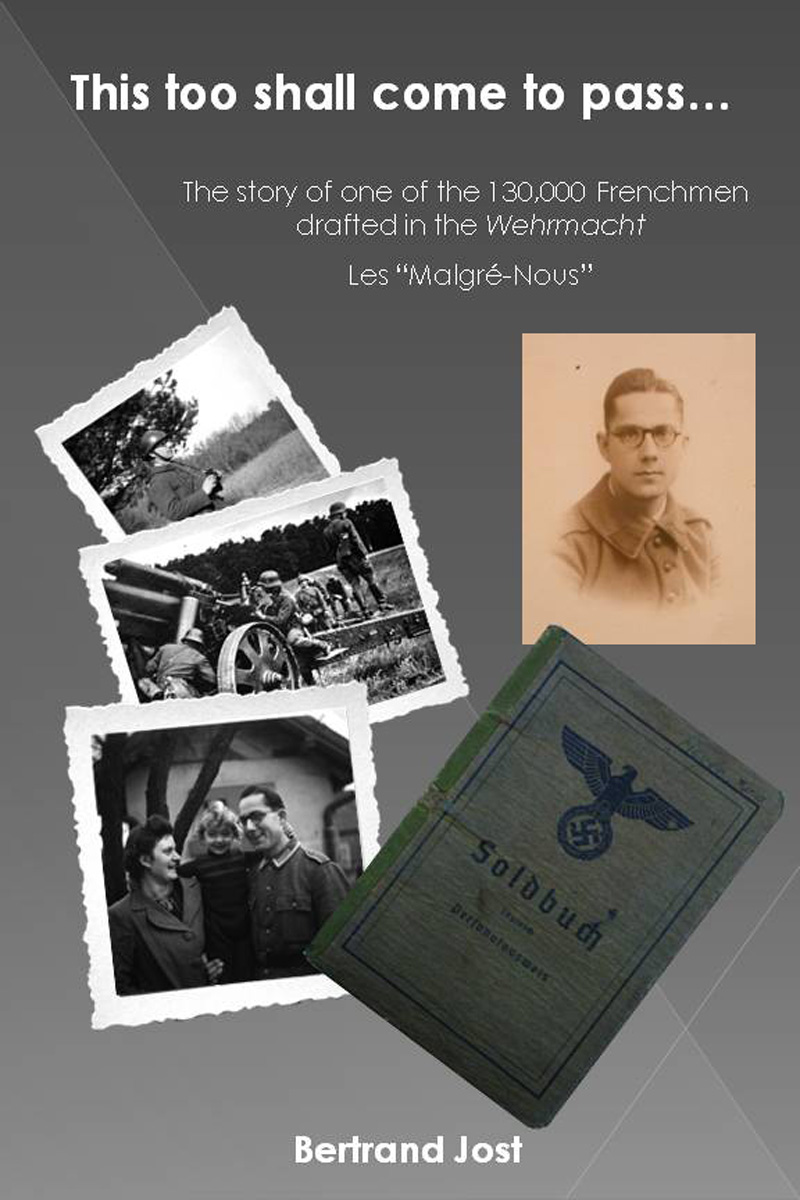
This
too shall come to pass - The story of the
Frenchmen drafted in the Wehrmacht
August 25, 1942. A day of infamy for
Alsace-Lorraine. The Nazis have just decided to
draft all Frenchmen of Alsace and Lorraine in the
Wehrmacht, the German Army. Later, many would even
be drafted in the infamous “Waffen SS”. For Marius
Meyer, my grandfather, the draft date was April 16,
1943, not even three years after he had been
discharged from the French Army in the wake of the
tragic defeat of 1940. But he has no choice for the
draft dodgers see their families deported somewhere
to the East. So he leaves his wife and daughter to
go to war, once again. His destination is Kustrin,
in Eastern Germany, a few steps closer to the much
feared Russian Front…
Marius wrote the following poem about this painful
moment of departure:
“Now goodbye you, my dear
homeland Dear land of Alsace, goodbye! We must go to a remote land! Dear land of Alsace, goodbye! And we leave with some … feeling. Gone to the Wehrmacht into the uniform – Dear homeland, oh dear! [ ] Thus they went through the town and land And were soon recognized everywhere A far-out hand wave, last moment of bliss And all this was already part of the past. And always resonates of home this melody Like the complaints of the little flower
from ‘Forget me not!’”
This book is the story of my Grandfather, one of the
130,000 Frenchmen drafted in the German Army during
World War II. 32,000 of them would be killed in
action and 10,500 are still missing in action to
this day.